
Say the word “nexacor” to anyone in the Empire, and an image of a raptor springs to mind, and for good reason. The raptor is by a large margin the most populous of the nexacor subspecies, and almost always the one shown by the news feeds terrorizing frontier colonies. It is built to feed the hive, and that means speed, power, and teeth.
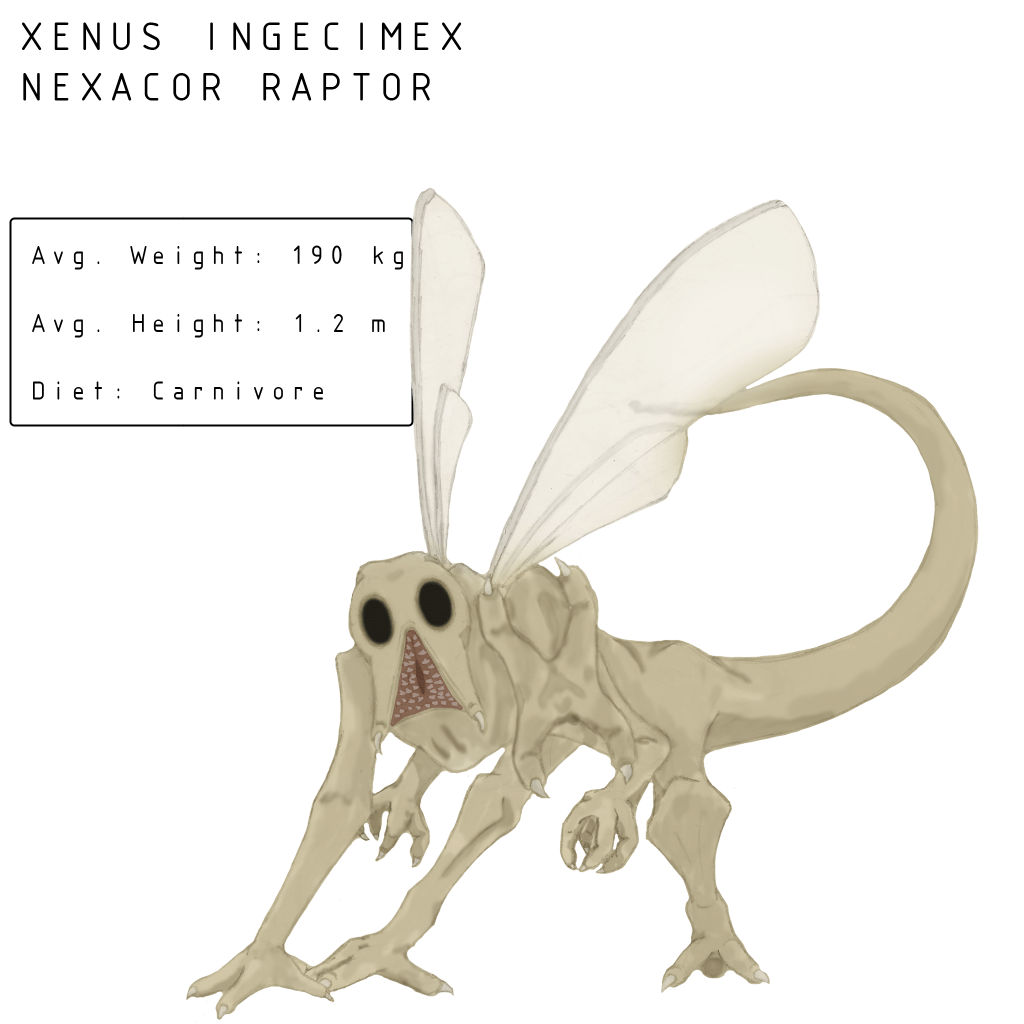
The raptor is perhaps most distinct from its fellow nexacors due to its keratinous wings, which, while not capable of providing sustained flight, greatly enhance the raptor’s running speed and jump height. Reports on both statistics vary wildly, but officially, raptors can reach speeds of up to 95 kilometers per hour and leap about 18 meters horizontally, or 8 meters vertically, depending on the atmospheric density and gravity of the environment.
While most other nexacor subspecies remain in the regulated environment of the hive, raptors must be able to survive a wide variety of harsh conditions to feed the ravenous hive. A raptor’s wings serve another important role in this context, able to radiate heat when fully splayed, or insulate the raptor by wrapping its torso.
Though not as sharp as the average human’s, a raptor’s vision extends well into the infrared spectrum, allowing it to detect even the most well-camouflaged prey by its thermal image.
Raptors are pursuit predators, using their superior speed and agility to run down their prey. On its own, a raptor is highly selective, seeking out targets decidedly slower and weaker than itself. In a pack, however, raptors regularly hunt prey several orders of magnitude larger and stronger than themselves. Rather than attempting to find a weak spot on every new alien prey they encounter, raptors have adopted a “death by a thousand cuts” approach, attacking from every angle until the target suffers a mortal wound or bleeds out.
Typically, raptor packs range in size from as few as 3 to as many as 40 members. When facing a large group of prey or, more importantly, a threat to the hive, many packs will band together to form a swarm. An average swarm consists of about 500 raptors. The largest swarm on record measured in at 23,000.
Regardless of a hive’s size, raptors present a constant threat on frontier worlds. Their insatiable hunger puts colonists, their livestock, and the surrounding ecosystem in jeopardy. Despite xenobiologists’ best efforts, the only effective solution to controlling a nexacor hive remains total extermination.
Copyright 2021 Richard Patton
 Voyager Dawn