
Because of the Empire’s brief stay on Dawn Six, not much is known about its wildlife outside anecdotal encounters and trap-cam footage. Aprum plectris is one of the few creatures Voyager Dawn’s biologists were able to study up close, as a result of one adventurous individual stowing away in Air Wing Lieutenant Goodman’s flight bag and capturing the hearts of Dawn’s crew under the adopted name, “Waffle”.
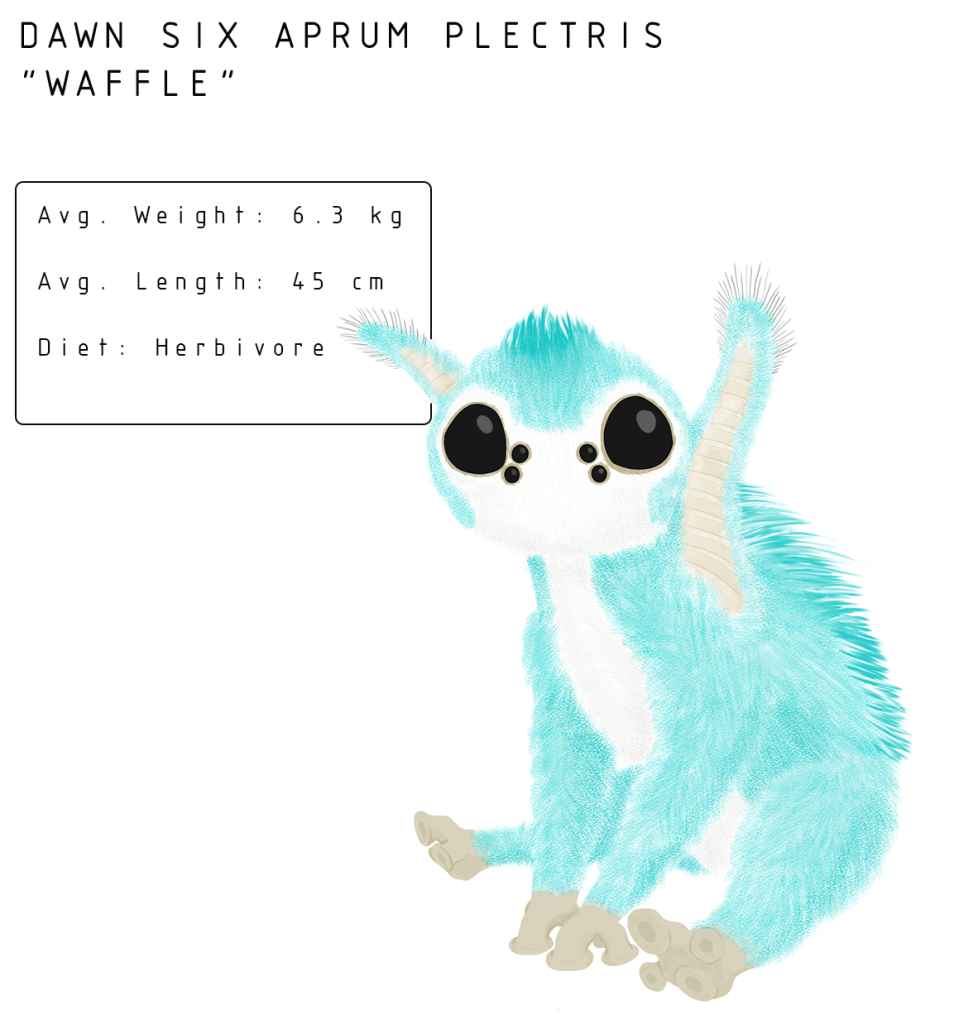
Waffle and his species spend their waking hours in the forests of Dawn Six, grazing on algae before retiring to the planet’s many caves at night. They sleep nestled in crevices, pointing their quills outward to deter probing predators like Canis rostrata, the Dawn Six Bullhound. While often seen alone or in only loose groupings during the day, they appear to prefer sleeping together, sharing warmth and multiplying the number of quills defending them.
Aprum plectris’ wide, flat mouth is hidden on the underside of its head, the better with which to scrape algae off rocks or skim it from the surface of ponds while keeping its head above water. This algae gives Aprum plectris‘ quills their deep teal hue, affording it camouflage against the similarly-shaded ground cover of its natural environment. Though largely conjecture, biologists guess that the vividness of color, as well as the density and size of their quills, may be indicators of an individual’s nutrition and consequently a display a virility when mating.
Aprum plectris‘ feet are designed first and foremost for sticking. The gecko-like pads of its toes allow it to cling to the slick surfaces of caves and ponds, and can even splay out to improve its efficiency while swimming.
Perhaps the species’ most remarkable trait is its wide array sensory organs. Its two largest eyes operate in the visual spectrum, while the two smaller pairs appear sensitive to ultraviolet and infrared light, providing a nearly full-spectrum image of its environment in all lighting conditions. The function of the tentacle-like appendages above its shoulders is less clear, though the fine hairs at the ends are likely touch-sensitive. Theories as to the purpose of the bare skin on the undersides of these appendages range from temperature regulation to electromagnetic detection to smell.
The outcast Naldim of Dawn Six appear to have domesticated Aprum plectris for both companionship and their incredibly acute senses, which can alert the Naldim to dangers they themselves are not able to detect. In exchange, Aprum plectris receives reliable shelter, warmth, and food.
This symbiotic relationship may have been what made Waffle so comfortable interacting with humans even in their first encounter – a seemingly inconsequential detail at the time that ultimately contributed to Dawn’s victory.
Copyright 2023 Richard Patton
 Voyager Dawn