
The latest in a long and ever-evolving line of Imperial colony ships, the Enterprise-class expanded humanity’s reach further than ever before. Of the six ships in the class, none is more famous than Voyager Dawn, which served as the flashpoint of the Naldim War.
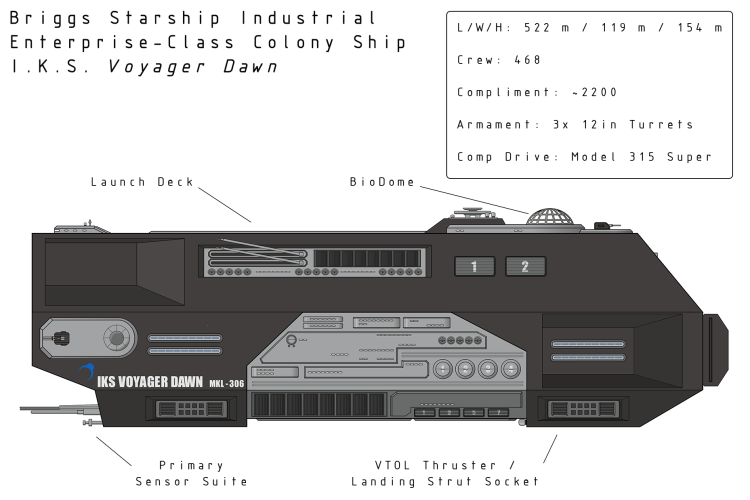
Measuring in at 522 meters long, Voyager Dawn and its sister ships are the largest colony ships to date, larger even than most military craft. Dawn supports hundreds of crew and thousands of colonists with a self-sustaining hydroponics bay, colloquially known as the “Biodome”, as well as vast cargo bays, a variety of amenities, and a fleet of support craft.
The Enterprise-class is exceptionally well-armed for a non-military vessel; a product of the Empire’s increasingly dangerous outer territories. Three twelve-inch dual-cannon turrets provide ample coverage from aerial and ground attacks when the ship is landed, and the upper hangar supports two squadrons of various strike craft to intercept more distant threats before they pose a danger to the mothership.
The pilots and marines onboard, however, are more than just security personnel. Every crew member is expected to serve in a variety of roles as the colony is established. Pilots double as drivers and machine operators. Marines comprise the bulk of the construction labor force. Engineers maintain not only the ship, but also lay the groundwork for colony infrastructure.
Because the ship and its crew are so integral to the settlement of the colony, the Enterprise-class – as well as most of its predecessors – are designed for planetary landings. Colony ships are the largest vessels capable of doing so, enabled by a unique landing cradle that is deployed to the planet’s surface ahead of the ship’s descent. The cradle uses an array of graviton projection plates – similar to those that provide gravity aboard a ship – to arrest the speed of the ship as it approaches the landing site. The array is used again to assist in takeoff after the colony is established, though the cradle is left behind to serve as a framework for government offices, shuttle pads, and a Sector Security outpost.
Approximately six months into a colony ship’s year-long settling period, a resupply ship known as a “Jumper Shuttle” arrives to restock the ship’s consumables, deliver new colonists bound for the next world, and deposit a new cradle in orbit, to be collected by the colony ship as it departs the system.
Though technically part of the Imperial Navy, colony ships operate within their own command sphere known as the Colonial Guard. The other branches of the Navy tend to consider the Guard an inferior division, citing a lack of combat experience and, more often, poor professionalism. This reputation is not unearned; long periods of downtime and regular interaction with colonists have led to a more relaxed environment aboard colony ships. It is not uncommon for crew and colonists to even have relationships, short-lived though they may be due to the nature of the job.
Nevertheless, the Colonial Guard have firmly rebuked this reputation time and again by establishing and securing prosperous colonies on a variety of alien worlds. The disdain for the Guard was finally put to rest when Voyager Dawn – not a warship – faced the opening salvos of the Naldim War and, against all odds, emerged victorious.
Copyright 2022 Richard Patton
 Voyager Dawn