
The standard infantry weapon has seen remarkably slow progress since the introduction of the automatic rifle in the 20th century, making incremental changes here and there while often regressing under the arguably flawed adage, “if it ain’t broke, don’t fix it”. The N/KR-223, colloquially known as the “Switchback”, was envisioned to push weapon design out of its rut, representing a culmination of years of technological advancements in a single jack-of-all-trades.
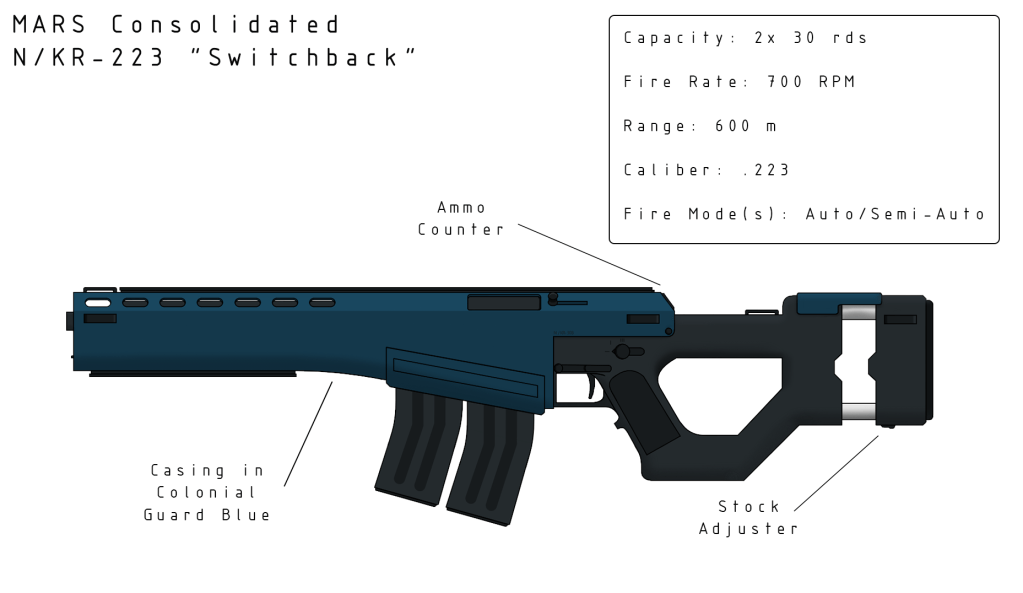
The KR-223 is the basis of a line of infantry weapons, ranging in caliber and size from the shorter-barreled UKR-223 close-quarters SMG to the MR-308 sniper rifle. While each has unique characteristics, they share most of the KR-223’s quality-of-life features, as well as its distinctive dual-magazine housing.
The Switchback’s twin magazines were originally meant to be mounted side by side, with a toggle controlling which magazine fed the firing chamber. The intent was for each magazine to be loaded with a different ammo type, allowing the user to rapidly switch as the situation demanded. Between issues with rounds jamming in the crossfeed, ergonomic discomfort, and the necessity often to eject an unspent round to switch feeds, the design was ultimately scrapped. The idea, however persisted.
The modern Switchback mounts the magazines one in front of the other, and only the rearmost magazine feeds into the chamber. When the rear magazine is removed, the forward magazine is automatically pushed into place by pneumatic rods and the first round is chambered. Rather than allowing ammo types to be swapped, this design enables a skilled user to continue firing while reloading by placing a new magazine in the now vacant forward slot, or simply enjoy twice the ammo capacity without the ergonomic issues of a drum magazine.
While the twin magazines are certainly the Switchback’s most unique identifier, it is loaded to bear with other technology to ensure maximum accuracy, efficacy, and ease of use. The plastic cowling around the barrel and receiver also houses a recoil damping system, integrated suppressor, and a sophisticated targeting suite that communicates ranging and environmental information to the user’s HUD. The rear of the shell displays the number of rounds remaining in the active magazine, and numerous mounting points and rails span the weapon’s length to accommodate straps, scopes, and other attachments. A small battery pack is mounted in the stock to maintain the onboard and attached electronics, and is kept charged by the kinetic energy of the recoil damper.
As the name implies, the KR-223 fires .223-caliber rounds (based on an archaic measurement system the Navy maintains, it seems, purely out of tradition). These rounds, like most Navy ballistic weaponry, are propelled by caseless cartridges. Though the Switchback appears to have ejection ports similar to those found on cartridge-ejecting weapons, these in fact serve to aerate the firing chamber after each shot, and can be locked open using either charging handle in case of a jam. Also rather uniquely, both sides of the weapon have an aeration port, and either can be set as the active port depending on the user’s handedness.
At the height of the Naldim War, the entire Switchback line was upscaled to contend with the Naldim’s natural resistance to small arms fire. While the UKR remained .223 caliber, the KR and MG were upgraded to .308 rounds, the MR sniper rifle to .50 caliber rounds.
Copyright 2022 Richard Patton
 Voyager Dawn